Outdoor Kitchen + Backup Power: The Complete Setup
A modern outdoor kitchen runs on electricity more than people realize: pellet grills need power for the auger, igniter, and controller (50–300W, with a brief ignition spike), and electric grills like the Ninja Woodfire or Weber Pulse pull 1,500W+ continuously. The fix is a power station sized to your grill — a 1,000Wh unit like the EcoFlow Delta 2 runs a pellet smoker for an entire low-and-slow brisket cook, while a 2,000W+ unit is required to even start an electric grill. Below we pair real grills with the power stations that keep them cooking off-grid, tailgating, or through an outage.
The cross-vertical comparison
Grill power draw vs. the minimum power station that can run it. Pellet/gas grills need only modest power for electronics; electric grills need high continuous output.
| Grill | Type | Power Draw | Min. Station Output | Pair With |
|---|---|---|---|---|
| Traeger Pro 575 | Pellet | ~50–300 W | 600 W+ | EcoFlow Delta 2 |
| Recteq RT-700 | Pellet | ~50–300 W | 600 W+ | EcoFlow Delta 2 |
| Weber Genesis S-335 | Gas | ~5–20 W (igniter/light) | 300 W+ | Any station |
| Ninja Woodfire Outdoor Grill | Electric | ~1,500 W | 2,000 W+ | Jackery Explorer 2000 Plus |
| Weber Pulse 2000 | Electric | ~1,800 W | 2,000 W+ | Jackery Explorer 2000 Plus |
Our picks across verticals

Traeger Pro 575
A Wi-Fi pellet grill that only sips ~50W once lit (with a brief ignition spike), so a single 1kWh power station runs an all-day brisket cook with capacity to spare.

Ninja Woodfire Outdoor Grill
A versatile electric grill/smoker that needs a true 2,000W+ power station to run — pair it with a Jackery Explorer 2000 Plus and you can grill anywhere there's no gas or grid.
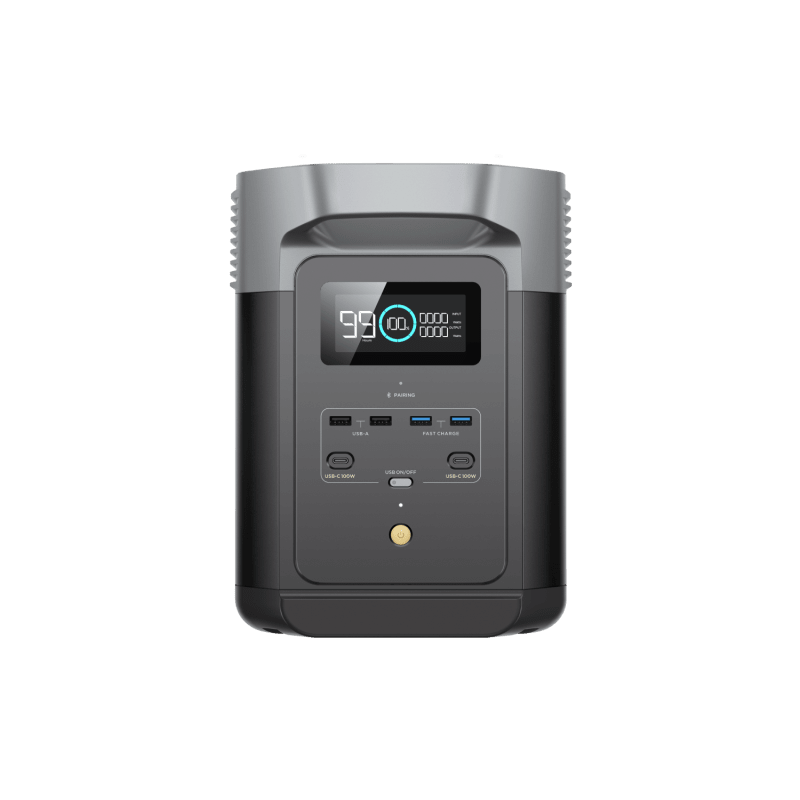
EcoFlow Delta 2
1,024Wh and 1,800W output absorb a pellet grill's ignition spike and run the auger/controller for a full 12+ hour cook — the sweet-spot station for outdoor cooking.

Jackery Explorer 2000 Plus
3,000W continuous output is enough to actually start and run a 1,500–1,800W electric grill, plus lights and speakers — the backbone of a portable outdoor kitchen.

Recteq RT-700
A larger pellet grill for parties; still low-draw once running, so a mid-size power station keeps it smoking through a backyard event even if the power blinks.
Go deeper
Frequently Asked Questions
Do pellet grills need electricity?+
Yes. A pellet grill uses electricity to run the auger that feeds pellets, the hot-rod igniter that lights them, and the digital controller that holds temperature. Running draw is low — roughly 50W once lit, with a brief spike of a few hundred watts during the first minute of ignition — so even a 1,000Wh power station like the EcoFlow Delta 2 can run a pellet smoker for an entire all-day cook.
What size power station do I need to run an electric grill?+
Electric grills like the Ninja Woodfire (~1,500W) and Weber Pulse 2000 (~1,800W) draw continuously, so you need a power station rated for at least 2,000W of continuous output. The Jackery Explorer 2000 Plus (3,000W) starts and runs them with headroom; a 1,000W-class station cannot.
Can I run my outdoor kitchen during a power outage?+
Yes — that's the whole point of pairing grills with a power station. Gas grills barely need power (just the igniter), pellet grills run all day on a 1kWh unit, and electric grills run on a 2,000W+ station. Keep the station charged and your outdoor kitchen becomes a backup cooking station when the grid goes down.
Which grill is best for tailgating or off-grid cooking?+
For low-and-slow off-grid smoking, a pellet grill like the Traeger Pro 575 paired with an EcoFlow Delta 2 is ideal — low power draw, long runtime. For fast electric grilling where there's no propane, the Ninja Woodfire on a Jackery Explorer 2000 Plus is the most versatile portable setup.
HomeGear Drip may earn a commission on purchases made through links on this page. Prices and availability are subject to change. Wattage and runtime figures are estimates to guide sizing, not guarantees.